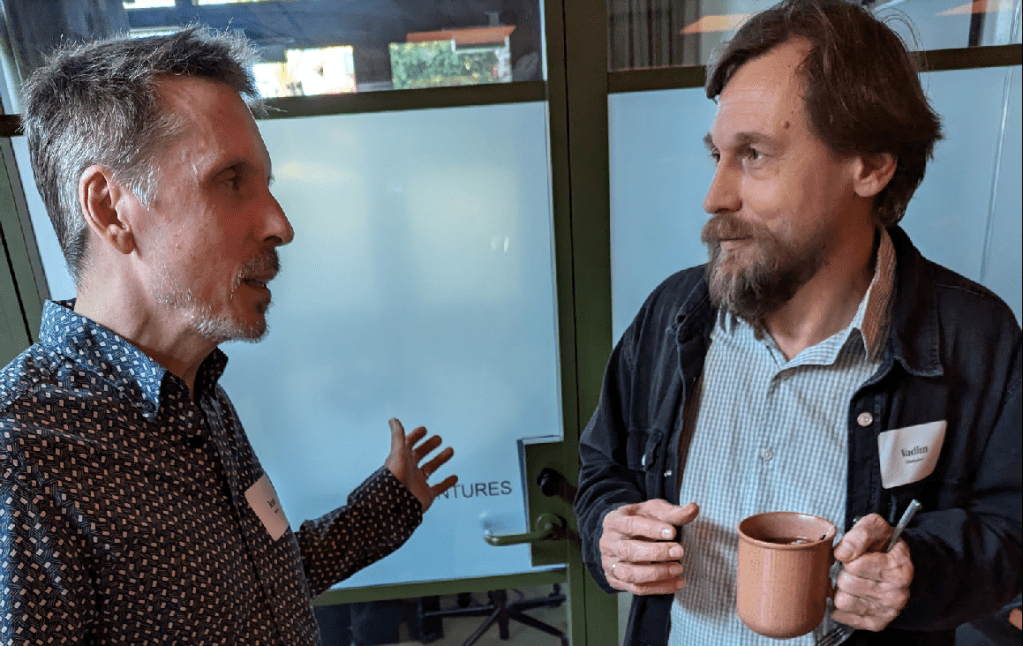
I recently attended the Longevity Frontiers Workshop, which was a fantastic event hosted by the Longevity Biotech Fellowship and the Foresight Institute. One of the highlights was an impromptu debate on the underlying mechanisms of aging between Jean Hebert and Vadim Gladyshev.
So, what is aging?
Aging is associated with adulthood, specifically the difference in appearance between young adults and old adults. Children also change over time, but they fill out and look healthier instead of withering away. This leads to a second feature of aging, which is that an aged adult is slower, weaker, and more likely to die than a young adult. However, functional decline also happens when someone has an infection. Infections usually pass after a while, but aging does not, so a third property of aging is that it does not resolve, but instead gets worse over time. Depending on circumstances, a person might temporarily appear a little younger than expected but, over the long run, age-related decline is not only inexorable, but the best we can hope for. Nobody dies suddenly of old age, so a fourth characteristic of aging is that it happens slowly. Adults don’t look older day to day, but if you see someone after twenty years you’ll notice age-related changes.
There are many things that kill us more quickly than old age, but they tend to attack a specific part of the body. Snake venom can prevent your heart from beating. Aging, on the other hand, is ubiquitous within the body. We would not expect half of someone’s body to age while the other half stays young, nor are there any organs or tissues that escape age-related decline. The biological systems of the body are very interconnected, and the aging process is not isolated to any particular part of the body the way acute trauma is. Not only is aging diffuse throughout the body, it is also multifaceted. Aging is not a singular problem, but the combination of a large number of contributing factors. We know that some of these factors are intrinsic to human life because we age regardless of where we live or what we do. Lifestyle can affect the rate of aging but, for us, aging is a natural part of life. Other factors are external, as seen by the negative effect that things like air pollution can have on lifespan. Lucky genes might keep you younger longer, but an unhealthy environment will age you faster.
So you could say that aging is the slow, progressive decline in function of the whole adult body due to a large number of intrinsic and external factors. Or that aging is a diverse set of processes that slowly degrade the entire adult body. The effect is clear, but what leads to the outward signs of aging? What changes within our bodies that leads to the stark contrast between someone when they are 25 years old and when they reach 75?
Looking at the underlying mechanisms, molecules in our bodies are always changing. Sometimes this is part of normal biological processes like storing and using fat reserves. Other times molecular change is a side effect, like when ATP production creates free radicals that go on to oxidize different parts of our cells. Changes also come from external factors like pathogens, pollution, and what we eat. When the molecules that make up our body change over time, our bodies change as well.
Molecular change is not inherently bad. Growing taller and stronger during puberty is very different from the shrinking brain and muscle wasting that occurs in old age. Aging isn’t just change, but change that eventually leads to disease and death. For example, about once a day the DNA in a typical cell breaks at some point along its length. The cell has proteins that repair these double-strand breaks, but occasionally a mistake is made that changes the genetic sequence of that cell. Most of the time this will have no effect, because a typical cell only transcribes a few percent of its genome, so changes in the vast majority of a cell’s DNA will not impact its function. Very rarely, a change might even improve the function of a cell, for example if someone has a disease caused by a gene variant with a single point mutation. More likely, though, is that DNA mutations can have a negative impact on cell function by creating a pathogenic variant of a gene.
Detrimental change can be referred to as damage. Most molecular changes are not damage, but even the ones that are damage do not necessarily cause aging because most damage is repaired by the body and has no long term impact. A paper cut eventually heals but, in order to produce a lasting effect like aging, the damage must also last. Your body experiences transient molecular damage all the time, but it is able to restore things quickly. For example, we don’t care much about proteins that get chemically altered but then quickly tagged for recycling in a lysosome. That is damage, but it is not aging because it doesn’t build up over time.
If our bodies were able to repair all damage, we would not age. Our bodies would change according to developmental programs, but then we would remain in young adulthood. Any brief departure from the healthy state we experienced would not result in aging. Humans have relatively good damage repair mechanisms, which is why we live so long compared to other animals, but there are many types of damage that our bodies cannot fix, like DNA mutations.
However, aging is not limited to irreversible changes. Even some reversible changes begin to accumulate in old age as the rate of damage accumulation surpasses the repair rate. For example, your body continuously accumulates senescent cells, but also clears them. As the immune system breaks down in old age, senescent cell clearance still happens, but some of them escape and build up in your tissues. That’s why senolytics are useful: they clear damaged cells that the immune system hasn’t been able to keep up with. Lipofuscin is also reversible in dividing cells but not non-dividing cells. That means that for rapidly growing organisms like children, lipofuscin is damage but not aging. For fully-grown adults, it is both damage and aging because it is a detrimental change that accumulates over time.
So what is aging from the perspective of underlying causes? Aging is the gradual accumulation of diverse damage throughout the body. It is this ever-growing damage burden that produces the ever-increasing problems associated with aging.
Damage accumulation is how microscopic changes eventually lead to macroscopic problems like functional decline and disease. DNA damage can lead to cancer. Lipids that usually support the cell membrane can become oxidized and disrupt the barrier instead. Sugars can undergo chemical alterations that lead to harmful intercellular communication. Proteins can become misfolded and lose their function, or even develop into clumps that kill cells. Our cells are programmed to make molecular changes that maintain or improve the function of our bodies but aging involves changes that reduce it. This could be the loss of useful molecules, like when an older body produces less collagen, which leads to weaker skin. Or it could be the addition of harmful molecules, like PCBs, that build up and cause cancer. Even normally helpful molecules can be made harmful, like when mitochondrial DNA is misplaced into the cytoplasm, causing an immune reaction. When there is a persistent drop in functional molecules or rise in dysfunctional molecules, either can negatively impact cellular processes, organelles, cell behavior, tissues, and organs.
Detrimental changes at all these levels of abstraction can be referred to as damage. Damage to cells, cell populations, tissues, and organs are all part of the aging process. But the reason for dysfunction at higher levels is the problems at lower levels. Organs are dysfunctional when their tissues have problems. Tissues have problems when their cells misbehave or their connective tissue gets altered. Cells misbehave because of problematic molecules in their internal or external environment. Aging is all due to molecular problems.
That said, it is useful to discuss aging at different organizational levels without having to always reference the underlying structure. So instead we talk about damage, which might include root causes or downstream effects. Then you can set aside the molecular mechanisms and examine aging at, e.g. a cellular level. You can say that immune cells becoming more inflammatory is a type of aging damage even if the underlying cause of the behavior is molecular changes to epigenetics. You can say that a heart is aged because it lost stem cells. You can say that a cardiovascular system is aged because the arterial walls are stiff. We don’t want to always talk about molecules, even though aging is fundamentally molecular.
So if we say that aging is the accumulation of a wide variety of damage throughout the body, we might be referring to damage at any level. Different categories of aging damage have been proposed at different levels of abstraction: molecules that do bad things, cells that misbehave, dysfunction of tissues and organs. For example, the SENS categories include both cellular and molecular damage.
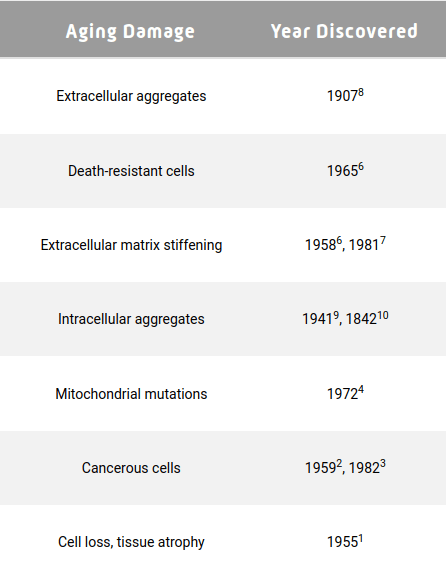
The third category above is often overlooked, but is very important because aging does not only occur in cells, but also to the extracellular matrix or ECM. The ECM is molecular scaffolding that cells produce to give shape to tissues and organs. It can have a variety of properties, like the rigidity of bone or the flexibility of skin. Aging of the ECM leads to bone fractures and wrinkles. ECM also affects cell behavior, so cells that live on old ECM will behave incorrectly and contribute to aging.
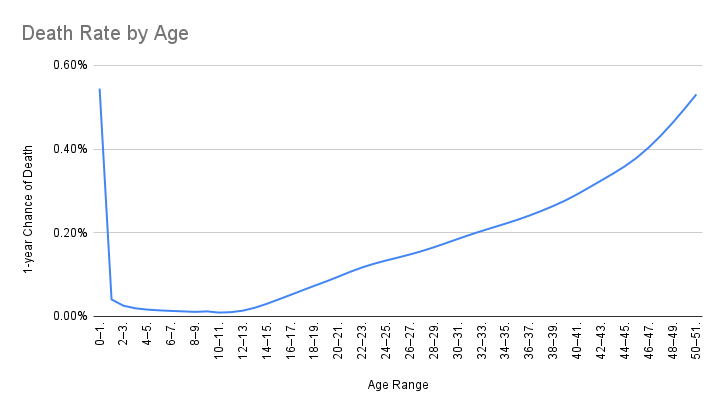
When enough damage is done to ECM and cells, either by the slow accumulation of changes that the body cannot fix, or a threshold of fixable damage is crossed that overwhelms the repair mechanisms, the aging process accelerates. We see this in mortality risk charts like the one below.

Mortality risk does not totally capture aging though. Aging occurs in the young, though at a slower rate that is masked by developmental changes. This is because in the first decade or two of life, developmental programs have a greater influence on mortality than aging. Even though aging occurs in children, their survival rate actually increases for a number of years as the benefits of development outpace any detriments from aging. Zooming in on the first fifty years makes it easier to see:
The progression of aging is even stranger at the very beginning of life. Each person is created from two parental gametes, but these cells are necessarily old and damaged when they meet. Once joined and a zygote is formed, it has mechanisms to repair damage faster than it accumulates. So the early embryo actually gets younger over the first few weeks, before the balance shifts back towards aging. That is why older parents, who have damaged sperm and eggs, can still produce young, healthy babies. The developmental process includes mechanisms for repairing many types of damage, some of which are not available to adults. For example, rapidly dividing cells can easily dilute intracellular junk and reduce their percentage of old and worn-out molecules. Unfortunately, adults cannot simply double in size to halve the amount of damage in cells and the extracellular matrix.
Similarly, functional decline is not a perfect view into the aging process. Some functional biomarkers have nice, smooth correlations with age. However, with others you may see no detrimental effect of damage accumulation until it reaches a certain threshold. After that, the functional impact may be sudden and devastating, like with stroke.
Instead of looking at one risk factor like mortality, or a handful of functional metrics, you can combine many data points into aging clocks. These are mathematical programs that operate on large numbers of biomarkers and can produce a biological age. Your biological age can tell you the relative amount of damage in your body, but this approach has issues because trying to compress aging into a single number discards the nuance of the problem. Aging is the accumulation of microscopic changes that add up to macroscopic dysfunction, like when the breakdown of elastin fibers in lungs makes it harder for the elderly to breathe. Two people who have the same biological age may have wildly different types of accumulated damage. So the abstraction might be useful as a general measure of health, but can be misleading about an individual’s health risks. It can also narrow thinking about how to reduce or reverse aging.
Another problem is that mapping aging onto chronological time takes something non-linear and maps it to a linear scale. But we know that the rate of aging is different during different periods of life. A 70-year-old accumulates more damage each year than a 30-year-old because the older we get the less effective our repair mechanisms become. We have also seen that adults typically go through accelerated periods of aging in their 40s and 60s.
In addition to aging at different rates over time, your body also ages at different rates in different organs. Aging happens on a molecular level, and can vary widely by tissue and organ. Someone who drinks alcohol might have a relatively old liver compared to the rest of their body, while someone who sunbathes might have relatively old skin. Aging within different organ systems can lead to different types of dysfunction.
Some groups are now moving to organ-specific clocks, which will be an improvement, but still hide important information. Do you have a 50-year-old heart because of cell population changes or protein aggregation? Not all types of damage are equally bad and different types of damage across different organs will respond differently to different interventions. The single measures from biological clocks hide the underlying complexity of damage and the complexity of the solutions needed to address it. So while biological age tests are useful, and organ-level tests will be more useful, even these will eventually be superseded by tests that can specify the level of different types of damage in specific tissues and organs.
In the meantime, what can we do? Damage is inevitable because of the nature of quantum mechanics. Molecular changes will occur to the vibrating molecules that make up our body just by chance. If you randomly change molecules in the body, most of the time those changes will be neutral or negative. The very rare positive changes can be good for large populations via evolution, but random change is generally bad for an individual.
However, even if damage is inevitable — aging is not. Aging is reversible, simply by reducing whatever damage has accumulated. An unhealthy lifestyle might lead to the early accumulation of damage that the body has mechanisms to repair. Better lifestyle choices can subsequently enable the body to reduce the total level of damage. This kind of reduction of the accumulated damage can’t reduce aging across the board because the types of damage that the body cannot repair are not reversible by lifestyle choices. That said, your total burden of damage can go down dramatically if you turn your life around after many sleepless nights of smoking, drinking, and eating candied bacon.
Lifestyle choices can cause large shifts in the level of accumulated damage. But there is no diet or exercise that can completely reverse even a single type of damage to zero, let alone all types of damage. Fortunately, your body is not the only way to reverse aging. Drugs, gene therapies, and replacement strategies can all reduce the accumulation of damage.
Pursuing therapies that target age-related damage will not only help people live longer, but will also work to prevent age-related disease. Alleviating the diseases of old age will have an incredible impact on both human health and longevity, with benefits not only to everyone as an individual, but to society as a whole. Understanding this and the nature of aging will help entrepreneurs decide what to work on, what investors should be funding, and hopefully help everyone live longer, healthier lives.
 Kris Borer